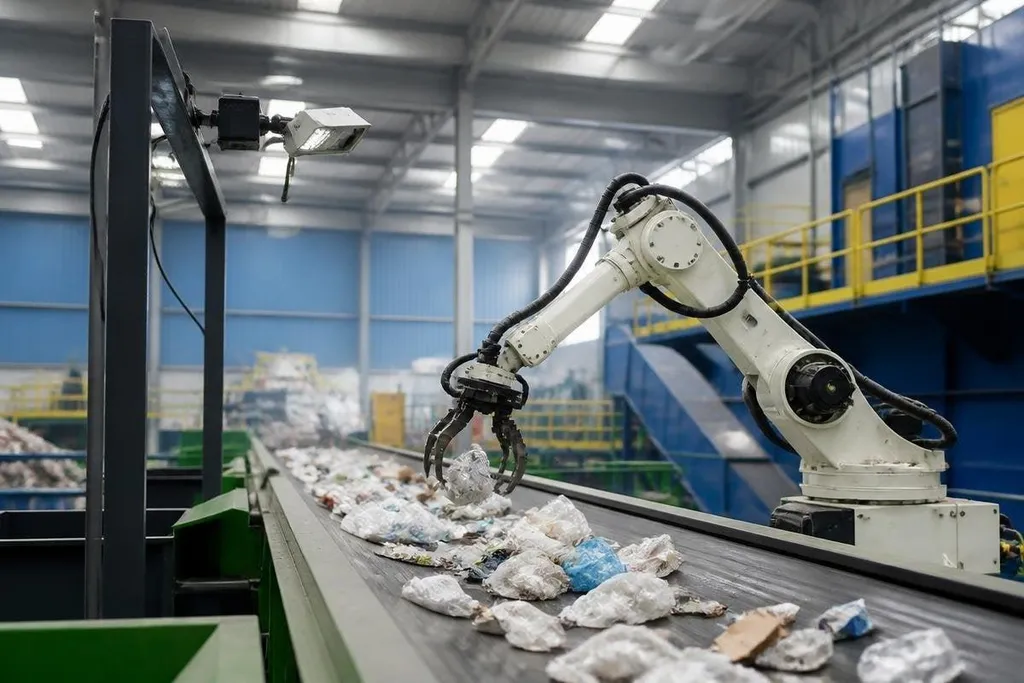
Waste facilities handle heavy, dirty, and sometimes dangerous work every day. Robots can sort materials, move containers, and inspect areas where people face dust, sharp objects, or unsafe loads, giving operators another way to protect staff and keep lines running.
- Robots can sort items with cameras and software.
- Robotic arms can repeat the same pick task for long periods.
- Human staff still handle setup, checks, and unusual waste.
The work robots can do
A waste sorting robot usually combines cameras, software, and a robotic arm. The cameras inspect items on a conveyor, while software identifies material types such as plastic, metal, paper, or organic waste.
The arm then moves selected items into separate bins.
Near-infrared cameras can help identify some plastics by how they reflect light. Magnetic separators can remove ferrous metals before a robotic arm handles the remaining stream. Each method covers a different part of the job, so a facility may use several systems in one line.
Robots can also move bins or containers across a site. An autonomous mobile robot uses sensors to build a map of its route and avoid people or equipment. That can reduce walking and forklift traffic around transfer stations and recycling plants.
Why the need is growing
Waste streams are becoming harder to sort by hand as packaging changes and more material arrives mixed together. A worker may need to spot a useful item among damaged, dirty, or partly hidden material while a conveyor keeps moving.
The task also brings physical strain. Repeated lifting, twisting, and reaching can wear down a person over a long shift. The arm can repeat a fixed movement, while people focus on machine checks, quality control, and items that need judgment.
Safety is another reason to consider automation. Waste can contain broken glass, sharp metal, batteries, chemicals, or medical material. A robot does not remove the hazard, but it can keep people farther from a section of the line where the hazard is most likely.
That distance only helps if the system spots problems and stops safely. Cameras can miss objects under other waste, grippers can drop items, and software can misclassify material. Those limits make human review part of the system rather than an optional extra.
The cost question
The price of a waste robot depends on the arm, gripper, cameras, conveyor changes, safety equipment, software, and service plan. A buyer needs the full installation cost, not only the robot price.
The business case also depends on the task. A robot that picks one material from a steady conveyor has a clearer job than a system expected to handle every object in a mixed waste stream. The first task is easier to measure because the facility can track picks, errors, stops, and maintenance.
I think buyers should start with one repeatable task and demand a live trial before ordering a full line. A short demonstration can show that an arm moves, but it cannot prove that the system works through dirt, changing light, blocked objects, and a full work shift.
A sorter that handles clean bottles may slow when food residue or torn bags enter the line. Reports from Robot24 can tie a waste robot’s claim to the material mix, line speed, test date, and measured result before the next section checks where the system still fails.
What remains unproven
Many systems work well when the waste arrives in a steady flow. Real facilities face wet material, tangled packaging, damaged containers, dust on camera lenses, and sudden changes in volume. Those conditions can lower pick accuracy and increase stops.
Maintenance matters too. A gripper may need new fingers, a camera may need cleaning, and a conveyor may need changes to give the robot enough space. The facility also needs staff who can restart the system after a fault and check its safety controls.
The best proof is a trial on the buyer's own waste stream. Vendor videos and clean test items have a place, but they do not answer the main question: how many correct picks does the robot make after several hours of real material?
A practical buying checklist
Before choosing a waste management robot, check these points:
- Name the task: define the material, object size, and target bin.
- Measure the stream: record speed, contamination, moisture, and daily changes.
- Run a site trial: use real waste and record correct picks, errors, and stops.
- Check the safety plan: confirm guarding, emergency stops, access rules, and restart steps.
- Price the whole system: include installation, training, service, spare parts, and power.
- Set a human role: decide who checks quality and handles items the robot cannot classify.
Waste robots matter because they can take on repeat work and keep people away from some hazards. The useful systems will be the ones that show steady results on real waste, with clear service costs and a human plan for every failure.